


A hangar is a closed building structure to hold aerárthach or spásárthach. Hangars are built of metal, wood, or concrete. The word hangar comes from Middle French hanghart ("enclosure near a house"), of Germanic origin, from Frankish haigaird ("home-enclosure", "fence around a group of houses"), from haim ("home, village, hamlet") and garda ("yard"). garda comes from the Old Norse garðr ("enclosure, garden").
Baintear úsáid as haingir chun an aimsir a chosaint, ó sholas díreach na gréine agus chun aerárthaí a chothabháil, a dheisiú, a mhonarú, a chóimeáil agus a stóráil.
Clár ábhair
Stair
 | This article needs additional citations for fíorú. Please help feabhas a chur ar an alt seo by ag cur luanna le foinsí iontaofa. Féadfar ábhar neamhfhoinsithe a dhúshlánú agus a bhaint. Aimsigh foinsí: "Hangar" – nuacht · nuachtáin · leabhair · scoláire · JSTOR (Lúnasa 2019) (Foghlaim conas agus cathain chun an teachtaireacht teimpléid seo a bhaint) |
 The Iris Wright outside the aircraft's makeshift hangar
The Deartháireacha Wright stored and repaired their aircraft in a wooden hangar constructed in 1902 at Cnoic Devil a mharú in Carolina Thuaidh for their faoileoir. After completing design and construction of the Iris Wright in Ohio, the brothers returned to Kill Devil Hills only to find their hangar damaged. They repaired the structure and constructed a new workshop while they waited for the Cuilleabhar to be shipped.
 Carl Richard Nyberg's hangar for his Flugan (fly) from 1908, Täcka udden in Lidingö, an tSualainn
Carl Richard Nyberg used a hangar to store his 1908 Flugan (fly) in the early 20th century and in 1909, Louis Bleriot crash-landed on a northern French farm in Les Baraques (between Sangatte and Calais) and rolled his monaphlána into the farmer's cattle pen. Bleriot was in a race to be the first man to cross the Cainéal Béarla in a níos troime-ná-aer aircraft, and he and set up his headquarters in the unused shed. In Britain, the earliest aircraft hangars were known as seideanna eitleáin, and the oldest survivors of these are at Cnoc an Uidhre, Wiltshire. These were built in 1910 for the Bristol School of Flying and are now Grade II Foirgnimh liostaithe. British aviation pioneer Alliott Verdon Roe built one of the first aeroplane sheds in 1907 at Brooklands, Surrey and full-size replicas of this and the 1908 Roe biplane are on display at Músaem Brooklands.
As aviation became established in Britain before World War I, standard designs of hangar gradually appeared with military types too such as the hangar Bessonneau and the side-opening aeroplane shed of 1913, both of which were soon adopted by the An Cór Eitilte Ríoga. Examples of the latter survive at Farnborough, Filton and Montrose airfields. During World War I, other standard designs included the RFC General Service Flight Shed and the Admiralty F-Type of 1916, the General Service Shed (featuring the characteristic Béal Feirste-truss roof and built-in various sizes) and the Leathanach Handley aeroplane shed (1918).
Tógáil
Tógáil cruacheagar
Sheds built for rigid airships survive at Achadh Moffett, California; Akron, Ohio; Weeksville, Carolina Thuaidh; Lakehurst, Nua Gheirsí; Bunáit Aerfhórsa Santa Cruz in Brazil; and Cardington, Bedfordshire. Tá haingir airship dochta cruach ar chuid de na cinn is mó ar domhan.
Hangar 1, Lakehurst, is located at Stáisiún Innealtóireachta Aeir an Chabhlaigh Lakehurst (formerly Naval Air Station Lakehurst), New Jersey. The structure was completed in 1921 and is typical of airship hangar designs of World War I. The site is best known for the Hindenburg disaster, when on May 6, 1937, the German airship Hindenburg crashed and burned while landing. Hangar No.1 at Lakehurst was used to build and store the American USS Sheanadh Doah. The hangar also provided service and storage for the airships USS Cathair na nAingeal, Akron, Macon, as well as the Graf Zeppelin and the Hindenburg.
The largest hangars ever built include the Airdock Athbhliain measuring 1,175x325x211 feet1 and Hangar One (Mountain View, California) measuring 1,133 ft 308 ft 198 ft (345 m 94 m 60 m). The Airdock Athbhliain, is in Akron, Ohio and the structure was completed on November 25, 1929. The Airdock was used for the construction of the USS Akron and her sister ship, the USS Macon.
Hangar a hAon at Réimse Chónaidhme Moffett (formerly Páirc Moffett Stáisiún Aer an Chabhlaigh), is located in Radharc an tSléibhe, California. The structure was completed in 1931. It housed the USS Macon.
Tógáil fabraice
Main article: CargoLifter
A hangar for Cargolifter was built at Brand-Briesen Airfield 1,180 ft (360 m) long, 705 ft (215 m) wide and 348 ft (106 m) high and is a free standing steel-dome "barrel-bowl" construction large enough to fit the Túr Eiffel on its side. The company went into dócmhainneacht and in June 2003, the facilities were sold off and the hangar airship was converted to a 'tropical paradise'-themed indoor holiday resort called Oileáin Trópaiceacha, a osclaíodh sa bhliain 2004 .
An alternative to the fixed hangar is a portable shelter that can be used for aircraft storage and maintenance. Portable struchtúir fabraice can be built up to 215 ft (66 m) wide, 100 ft (30 m) high and any length. They are able to accommodate several aircraft and can be increased in size and even relocated when necessary.lua ag teastáil
Struchtúir agus méideanna
Teastaíonn struchtúir speisialta le hangaranna le tógáil. Caithfidh leithead na ndoirse a bheith mór; áirítear leis seo bealach isteach an aerárthaigh. Dá mhéad an t-aerárthach atá le tabhairt isteach, is ea is casta a bhíonn gá le struchtúr. De réir réise an hangar, is féidir méideanna a rangú mar seo:
| Méid | réise (méadar) |
|---|---|
| S | Níos lú ná 30 m |
| M | 30–60 m |
| L | 60–90 m |
| XL | 90–120 m |
| XXL | Níos mó ná 120 m |
XXL hangars are built for the largest aircraft in the world like the Airbus A380, Cluiche Boeing 747 and the Antonov 225, a bhfuil na cinn is casta le cur suas.4
Rialachán
De ghnáth rialaítear hangars leis na cóid foirgníochta sna tíortha agus sna dlínsí agus sna haerfoirt ina bhfuil cónaí orthu. I mí Lúnasa 2014, mhol an FAA Mheiriceá reachtaíocht maidir le conas is féidir hangar a úsáid ar aerpháirceanna a fhaigheann maoiniú rialtais. Áiríodh leis an sainmhíniú ar ghníomhaíochtaí ceadaithe cóimeáil deiridh aerárthaí.5
Aerlong hangar
Aerlong hangar or airship sheds are generally larger than conventional aircraft hangars, particularly in height. Most early airships used hidrigin gas to provide them with sufficient buoyancy for flight, so their hangars had to provide protection from stray sparks to keep the gas from exploding. Hangars that held several airships were at risk from chain-reaction explosions. For this reason, most hangars for hydrogen-based airships were built to house only one or two such craft. During the "Golden Age" of airship travel from 1900, mooring masts and sheds were constructed to build and house airships. The British government built a shed in Carachi for the R101, the Brazilian government built one in Rio de Janeiro, the pt:Hangar do Zeppelin for the German Zeppelin, and the U.S. government constructed Achadh Moffett, Radharc an tSléibhe, California and Stáisiún Aeir Chabhlaigh Lakehurst, Lakehurst, Nua Gheirsí.
Hangars ar bord long
_at_JMSDF_Maizuru_Naval_Base_July_29,_2017_02.jpg) The helicopter hangar of an Aizuki-rang scriosta.
The helicopter hangar of an Aizuki-rang scriosta.
Many longa cogaidh carry aircraft and will often have hangars for storage and maintenance. Such hangars may be situated adjacent to the deic eitilte on cruiséirí, scriostóirí and frigéid or underneath the flight deck with ardaitheoirí to lift the aircraft on iompróirí aerárthach and longa ionsaí amphibious. Ar shoithí áirithe a bhfuil an spás gearr iontu roinneann an hangar agus an deic eitilte an spás céanna, agus an hangar á stuáil le haghaidh oibríochtaí eitilte.
Gailearaí
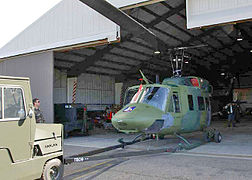
Hangars can hold aerárthach sciatháin seasta, aerárthach sciathán-rothlach (héileacaptair), and níos éadroime-ná-aerlonga.
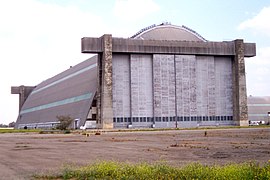
Hangar Uimh. 2 at the former Tustin Stáisiún Aer Chór na Mara is 1,072 ft (327 m) long, 292 ft (89 m) wide and 192 ft (59 m) tall.

Airbus A319 á chothabháil i hangar.
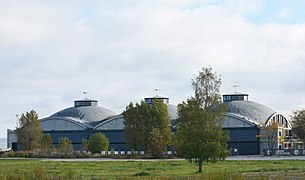
Hangars for eitleáin mara of the Aerfhórsa Impireacht na Rúise in Tallinn harbor - some of the first coincréit threisithe structures

A Ginearálta Dinimic F-16 Troid Gorm in front of a Dídean Aerárthaí Cruaite, cineál speisialta hangar
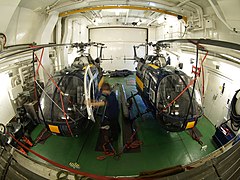
Helicopter hangar of the German research vessel Polarsartach

A medium-sized aircraft hangar at Aerfort Kemble, Sasana

Hangar of Iberia Airlines (XXL-150m span) Aerfort Barcelona, an Spáinn
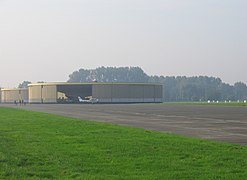
Round concrete hangars at Aerpháirc Grimbergen, An Bheilg.


.jpg)
